
Most buyers ask what an MXDR provider will catch. Fewer ask what it will do once ransomware is already moving through their network, and where that work stops. Those are the questions that matter at 2 a.m. Better to know before an incident than during one.
What does an MXDR provider do when ransomware starts?
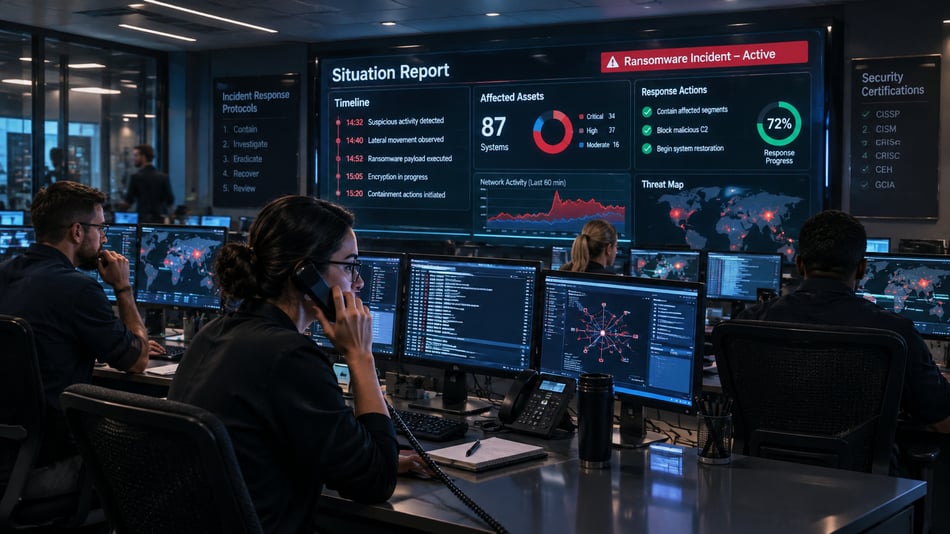
An MXDR provider's job in the first minutes is to see the attack, confirm it, and stop it from spreading. At Gradient Cyber, Quorum AI (QAI) correlates signals across network, endpoint, identity, SaaS and cloud into a Situation Report (SitRep). Containment then starts automatically where you have pre-approved it, or through your team where you haven't.
Ransomware rarely starts with encryption. Before the ransom note, attackers move laterally, call home to command-and-control infrastructure, and stage data for theft. Network traffic shows that activity whether or not an endpoint agent catches it, which is why we treat the network as ground truth. We walked through those stages in what a school cyberattack looks like before the ransom note.
Once QAI confirms the activity, three things happen:
- A SitRep goes out. It covers the timeline, affected users and assets, MITRE ATT&CK mapping, the supporting alerts behind the finding, and step-by-step response actions.
- You get notified. Critical incidents come with a phone call as well as the SitRep. Our response-time targets by priority are published on our MXDR page.
- Containment starts. With Active Response, pre-approved actions run through your own tools: isolating a host, killing a process, quarantining a file through your EDR, disabling an account or revoking sessions in Entra ID, or pushing a block to your firewall. With passive response, which is included in every subscription, your team or MSP executes the actions from the SitRep.
Who decides when to isolate a machine or disable an account?
You do, before the incident. Gradient Cyber customers with Active Response agree on an Authorization Matrix that lists which actions we can take on our own and which need your approval. Pre-approved actions run automatically. Everything else waits for a yes from you or your MSP. Nothing disruptive happens outside that agreement.
Buyers ask this in different ways. One IT director told us that if his machines were infected and spewing junk, he wanted us to shut them down. Others ask whether we would have access to their systems or only send recommendations, and whether response can be tailored to their own use cases.
The answer to all three is yes, and you choose the mix. The matrix is set per integration, so you can pre-approve endpoint isolation but keep account changes for your own team. You can also start with passive response and move actions into the pre-approved column as trust builds. Deciding this in advance is the point. Nobody should be debating authority while an attacker is moving.
Where does an MXDR provider's job stop?
MXDR stops at the edge of detection, investigation and authorized containment. Gradient Cyber does not perform full digital forensics, on-site containment, negotiation with threat actors, or system recovery. We also do not log into your routers and servers to rebuild them. Those jobs belong to your IT team, your MSP, or an incident response partner.
A prospect once asked us whether we would log into a router and bring it down ourselves. It's a good question, and the answer is no. We aren't your MSP, and an MXDR provider that implies otherwise is setting you up for an uncomfortable surprise mid-incident.
Here's how work gets divided:
- Gradient Cyber MXDR: 24x7 detection, correlation, SitReps, notification, authorized containment through your tools, and guidance through to resolution.
- Your IT team or MSP: changes to systems and infrastructure, restores from backup, and actions you have not pre-approved.
- An IR partner: full forensic investigation, on-site response, threat actor negotiation, and recovery support.
What happens when an incident outgrows MXDR?
When an incident needs hands on keyboards inside your environment, or forensic work needed by insurers and counsel, an incident response firm takes over. Gradient Cyber stays engaged, keeps detecting, and gives responders the telemetry and SitRep history already collected, so they aren't starting from zero.
At that point the organization is in serious trouble, and what matters most is competence: people who have run this kind of response many times and know exactly what to do, and in what order. A common mistake is picking a firm in the middle of the crisis. Precious hours go to finding a provider, signing contracts and agreeing rates, while the attacker keeps working.
How does an IR retainer close the gap?
An IR retainer settles the paperwork, contacts and escalation path ahead of an incident, so response starts with the first call. Gradient Cyber offers two: a Zero-Dollar IR Retainer included for MXDR customers, and an IR Partner Retainer that adds prepaid hours with our IR partner at a discounted rate.
- Zero-Dollar IR Retainer. Costs nothing to put in place. Before an incident, we review your IR plan and your log configuration for forensic readiness, and agree response scope, contacts and escalation in advance. During an incident, we lead remote triage, investigation and containment. If you need hands-on partner support, it's available and billed only if you use it.
- IR Partner Retainer. For organizations whose insurer, board or regulators expect an IR firm already under contract. Partner contracts and rates are determined in advance, on-site support is available, and the arrangement is built with your cyber insurance requirements in mind.
For QAI customers, there is a practical advantage. Responders work from the correlated telemetry, detections, SitRep history and asset context already in the platform. The evidence base exists before the first IR call is made.
What should you settle before an incident hits?
Decide who can act, who gets called, and who does the hands-on work. Much of the damage in a ransomware incident happens in the first few hours, and the worst use of those hours is making decisions that could have been made well in advance. A short list covers most of it:
- Authorization. Which containment actions your provider can take without asking.
- Contacts and escalation. Who gets the phone call at 2 a.m., and who backs them up.
- Your MSP's role. What they own during an incident, written down.
- An IR firm under retainer. Contracts and rates agreed before you need them.
- Insurer requirements. What your cyber policy expects from your response, and which firms it accepts.
- Log retention. Enough history for an investigation. Our SIEM post covers how long logs should be kept and why.
Frequently asked questions
Does Gradient Cyber negotiate with ransomware operators?
No. Threat actor negotiation is specialist work, and is handled by our IR partner. Gradient Cyber continues detection and supports the IR team with the telemetry and SitRep history already in Quorum AI.
Can MXDR contain ransomware if our network isn't segmented?
Isolating infected endpoints, disabling compromised accounts and blocking traffic at the firewall can slow an attack and buy time. They don't replace segmentation. A flat network gives an attacker more room to move, so segmentation is a solid move alongside MXDR.
Is the Zero-Dollar IR Retainer actually free?
Yes, to put in place. The retainer, the pre-incident reviews and our remote response come with Gradient Cyber MXDR. If an incident needs hands-on partner work, that work is billed only if you use it.
Do we need Active Response, or is passive response enough?
Detection and SitRep quality are identical in both. The difference is who executes the response. Passive response is for teams that want to keep enforcement in house or run changes through an MSP. Active Response is for teams where speed of containment matters most. With Gradient Cyber, you can move between them as your needs change.
Know where your provider's job ends before an incident, and have someone in place for everything past it. To set up a Zero-Dollar IR Retainer as part of Gradient Cyber MXDR, talk to our team.