
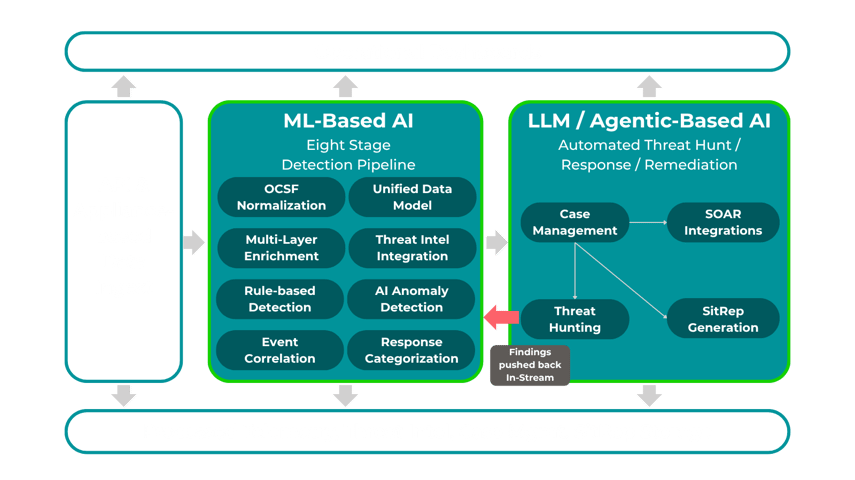
Quorum AI combines two distinct AI approaches within a single operational framework. The 8-stage detection pipeline uses machine learning for behavioral anomaly detection, threat intelligence correlation, and risk scoring. On the response side, LLM and agentic AI power automated threat hunting, SitRep generation, case management, and SOAR-driven containment workflows. Human analysts remain in the loop at critical decision points, validating findings and approving response actions before they reach your team. Investigative learnings are continuously fed back into the detection pipeline, so the system gets sharper over time.
AN AI-NATIVE MXDR PLATFORM BUILT FOR U.S. MID-MARKET ORGANIZATIONS.
Quorum AI: AI-Native MXDR for the Mid-Market
Quorum AI runs every event through a structured 8-stage detection and response pipeline, from OCSF normalization through enrichment, dual-engine detection, correlation, and analyst-validated response. The result is faster detection, clearer analysis, and more consistent outcomes without added operational complexity, backed by a decade of platform operations.
AI-Assisted Detection & Response
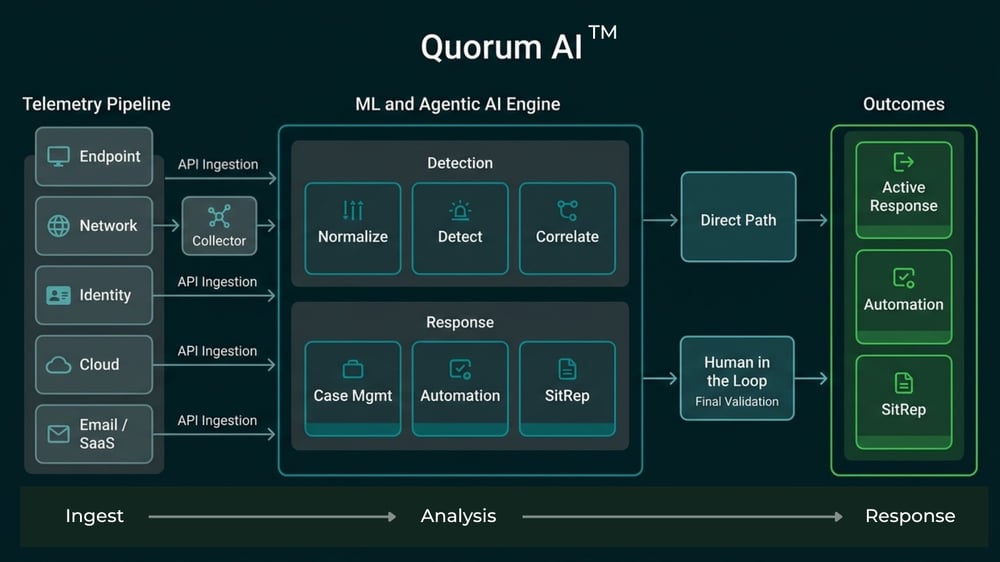
How Quorum AI Turns Telemetry Into Action
Quorum AI processes security telemetry through a structured detection and response pipeline that filters noise, enriches context, and surfaces what actually matters. Instead of forcing analysts to sift through raw events, it converts high-volume telemetry into prioritized, actionable intelligence.
- Normalize: Standardizes all events into OCSF and enriches with asset, user, and business context
- Enrich: Adds DNS, GeoIP, asset inventory, and vulnerability intelligence to every signal
- Detect: Combines Sigma rules with behavioral models to identify known and unknown threats
- Correlate: Links events into attack narratives mapped to the MITRE ATT&CK framework
- Respond: Routes findings to automated actions, investigations, or threat hunting workflows
Quorum AI Technology
Inside the Platform: How ML and Agentic AI Work Together
Why Quorum AI Is Different
Built to Reduce Noise, Improve Clarity, and Scale Security Operations
Quorum AI was designed to address the practical challenges security teams face every day: too much data, too many alerts, and not enough time or expertise to connect the dots. By applying AI-assisted analytics across the full detection and response lifecycle, Quorum AI helps reduce alert noise, improve investigative clarity, and deliver consistent outcomes at scale, without adding operational complexity.
-3.png?width=750&height=490&name=Macbook%20Pro%20with%20Beacon%20Dash%20Black%20Bkgd%20(750%20x%20490%20px)-3.png)
-
AI-Assisted Correlation, Not Just Alerts
Quorum AI continuously links signals across telemetry sources, time, and context to surface true risk earlier and reduce false positives.
-
Faster, Clearer Investigations
Automated enrichment and correlation accelerate investigations while preserving expert human oversight where it matters most.
-
Consistent, Actionable Response
Built-in workflows and response guidance help ensure incidents are handled consistently, even as environments and volumes scale.
-
Reporting That Drives Decisions
Clear, contextual SitReps and executive-ready reporting translate technical findings into business-relevant insight.
- Links activity across time, assets, users, and data sources to expose hidden attack paths
- Reduces false positives by evaluating signals in context, not isolation
- Elevates weak but meaningful indicators earlier in the attack lifecycle
- Automatically enriches alerts with asset, identity, and behavioral context
- Preserves analyst judgment while reducing time spent gathering evidence
- Shortens investigation cycles without sacrificing accuracy or oversight
- Applies workflow-driven guidance to ensure repeatable response outcomes
- Scales response quality across environments and analyst experience levels
- Supports human-led decision making, with automation where it adds value
- Translates technical findings into clear, executive-ready SitReps
- Supports compliance, risk reporting, and customer communications
- Connects security activity to business impact and priorities
#faqs
Frequently Asked Questions
Have Question? We are here to help
Do we have to replace our existing security tools?
No. Quorum AI is data-source agnostic and ingests from the tools you already run.
Endpoint: SentinelOne, CrowdStrike, Microsoft Defender, Carbon Black, Sophos. Firewall and network: Fortinet, Palo Alto, Cisco, Check Point. Identity: Active Directory and Entra ID. SaaS: Microsoft 365 and Google Workspace. Cloud: AWS and Azure.
Telemetry arrives by API, syslog, native log forwarding, or the Quorum Collector for network data. Everything is normalized to a common schema before analysis, which is what makes correlation across those sources possible.
If you ask us to recommend an endpoint tool, we recommend SentinelOne and we can supply it. That is a recommendation, not a requirement, and it changes nothing about what Quorum AI ingests.
What actually gets installed in our environment?
For most telemetry, nothing. Endpoint, identity, SaaS and cloud data connect through APIs and log forwarding, using credentials you provision and can revoke.
Network monitoring is the exception. It requires a Quorum Collector, a physical or virtual appliance deployed out of band on a TAP or mirror port. Out of band means it observes a copy of traffic and sits outside the path of production data. There is no endpoint agent involved in network visibility.
Onboarding runs in four steps: environment assessment, Collector deployment where network monitoring is in scope, API and telemetry integration, then operational handoff. Gradient Cyber runs the process. Your network team configures the mirror port, since that is a change on your own switching. Monitoring begins at handoff.
We have multiple sites. Do we need a Quorum AI Collector at every one?
That depends on perimeter points, not site count.
A Quorum AI Collector sees traffic at the point where it is mirrored to it. Customers who want network monitoring need at least one. If you have several perimeter egress points you want watched, each one needs its own collection. Sites that backhaul through a central perimeter are covered by the Collector watching that perimeter.
Endpoint, identity, SaaS and cloud telemetry are unaffected by how many sites you have, because that data arrives through APIs regardless of location.
Collector count is determined during the environment assessment and reflected in your quote, so the scope is settled before you sign.
Do you replace our SIEM, and how long do you keep our logs?
Quorum AI includes 14 days of hot data in Pulse. That is the active investigation window, and it covers the period nearly all detection and triage work happens in. Extended retention of a rolling 365 days is coming later this year as a purchasable option.
Whether that replaces your SIEM depends on what you use it for.
If you use it as the place security telemetry lands so it can be correlated, investigated and acted on, Quorum AI covers that work today, and does the correlation for you rather than waiting for someone to write the query.
If you rely on it to hold a year or more of logs for compliance or to hand to a forensics firm, the included 14 days does not cover that. Extended retention is what closes that gap.
If you use it for non-security operational logging, application analytics, or as a general data lake, Quorum AI is not a replacement for those.
What can you actually do when you find something, and who authorizes it?
Two modes, and you decide which applies to each action type before anything is live.
The default is passive. Every validated incident becomes a SitRep from a named Cyber Analyst, carrying the supporting telemetry, a severity and confidence rating, and prioritized recommended actions. Your team or your MSP executes.
Where you authorize it, Quorum AI orchestrates active response through systems you already own: host isolation, process termination and file quarantine through your EDR; account suspension and credential revocation through Active Directory or Entra ID; policy changes through your firewall.
Authorization scope is agreed per action type in advance, sensitive actions require analyst validation, and every execution is logged and auditable.
Quorum AI does not enforce actions directly. It orchestrates them through your enforcement systems, so administrative control of your infrastructure stays with you.
Where the line sits: this is detection and immediate threat response, not a digital forensics and incident response retainer. Gradient Cyber does not perform full DFIR, on-site containment, threat actor negotiation, or system recovery. For those we bring in an established IR partner and keep our own detection and advisory running alongside.
See Quorum AI in Action
Experience Quorum AI in a Live Demo
See how Quorum AI processes real security telemetry, surfaces true risk earlier, and delivers clear, actionable insight — delivered by Gradient Cyber’s human-led MXDR team, without increasing operational complexity.