
Cut Through the Noise. Stop Threats Sooner.
Gradient Cyber's MXDR combines a structured AI-powered detection pipeline with human-led analysis and response, so you can stop threats early, without drowning in noise.
You’re not alone - and it’s not your fault.
- Buried under alert noise and meaningless false positives?
- Struggling to monitor your environment 24/7 with limited staff?
- Falling behind on threats that now target every corner of your business, from endpoints to cloud to SaaS apps?
- Losing precious time to identify and respond before damage is done?
These aren’t just pain points. They’re entry points for attackers.
And as environments grow more distributed and data volumes explode, those entry points multiply faster than most teams can reasonably manage.
Mid-market organizations like yours face the same threats as global enterprises, but with a fraction of the resources. Traditional tools and siloed services can’t keep up with the speed, scale, and sophistication of modern cyberattacks.
But you don’t have to keep playing defense.

Why Traditional MDR Breaks Down at Scale
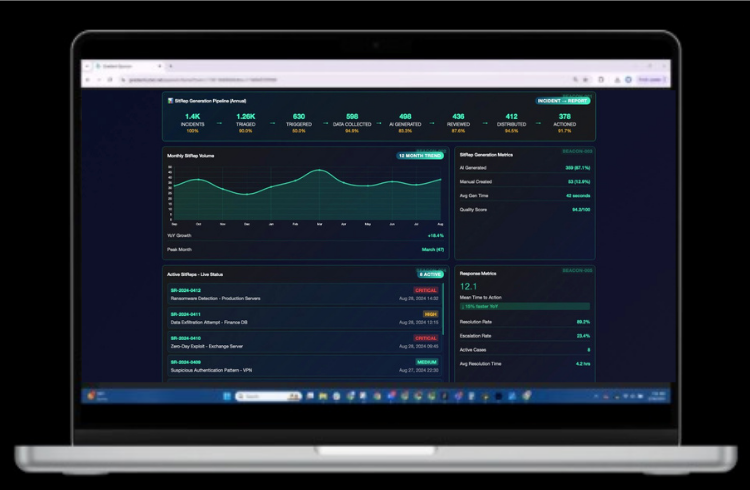
MDR was built for simpler environments. Today’s threats move laterally across endpoints, networks, cloud services, SaaS applications, and identities, often faster than humans or siloed tools can keep up.Modern security teams need more than monitoring and alerting. They need continuous correlation, context, and prioritization across the entire attack surface.
-
Covers network, endpoint, cloud, SaaS, and applications
-
Connects signals across tools, time, and environments
-
Prioritizes true risk over raw alert volume
-
Combines AI-assisted analysis with human expertise
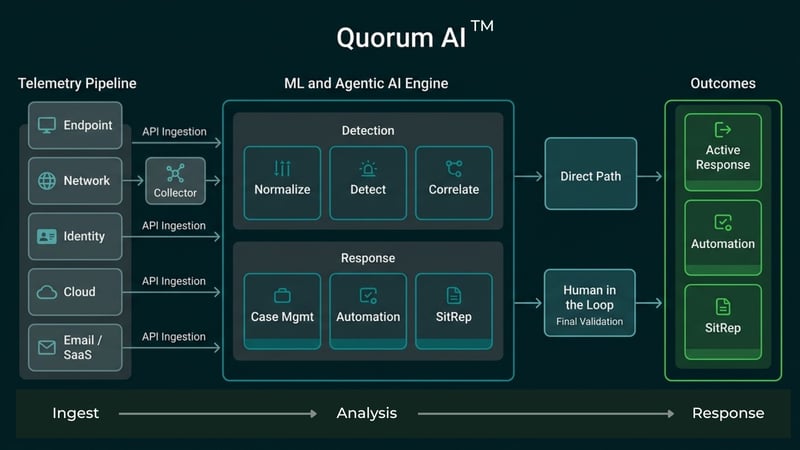
This is exactly why Gradient Cyber built Quorum AI around an 8-stage detection and response pipeline. Rather than bolting AI onto legacy workflows, the pipeline applies structured analysis at every stage, from telemetry normalization through enrichment, rule-based, machine learning and agentic AI detection, correlation, and automated response, so the context is already there when a finding reaches you or an analyst.
What Makes Gradient Cyber’s MXDR Different
Most providers talk about alerts, dashboards, and tools. We focus on outcomes.Gradient Cyber’s MXDR combines AI-assisted detection, human-led analysis, and real operational context to help mid-market teams detect threats earlier, investigate faster, and respond with confidence, without adding complexity.
People Who Know Your Stack
You won’t be passed between generic analysts or anonymous support queues. Our SOC analysts work with your environment every day, building continuous context across your users, assets, and risk profile, so investigations get faster and decisions get better over time.
-
24/7 SOC, with Tier 3 analysts in the U.S.
-
Analysts who learn your environment and priorities, not a rotating queue
-
Continuous context building with no repetitive ramp-up or handoffs
A Platform That Cuts the Noise
Our MXDR is powered by Quorum AI, a cloud-native platform built around an 8-stage detection and response pipeline. Telemetry from every source is normalized to the OCSF standard, enriched with context and threat intelligence, analyzed by rule-based detection, machine learning and agentic AI workflows, correlated into attack narratives mapped to the MITRE ATT&CK framework, and categorized for automated or analyst-led response.
-
8-stage pipeline processes telemetry from ingest through automated response, not just alert generation
-
Three detection layers: Sigma-based rules for known tradecraft, Vertex AI behavioral models for novel threats, and agentic AI workflows that draft each SitRep
-
ATT&CK-mapped correlation connects signals into kill chain narratives, not isolated alerts
Threat intelligence from a broad set of sources, built into how every finding is scored
Coverage Without Compromise
Attackers don’t stop at the endpoint and neither do we. Our MXDR provides full-surface visibility across on-prem, cloud, SaaS, and hybrid environments without forcing tool rip-and-replace or disrupting operations.
-
Full-surface detection across network, endpoint, cloud, SaaS, and applications
-
Integrates with your existing security and IT stack
-
Continuous visibility across users, assets, and activity
How fast does Gradient Cyber detect and respond?
Typically about 28 minutes from an event in your environment to notifying you, inside our 30-minute target for critical findings.
5.6 min
Typical time to detect
From the event at the source to a confirmed detection
21.9 min
Typical time to respond
From first alert to customer notification
30 min
Critical (P1) target
Phone call, email or SMS, and a SitRep alert
Response targets by priority
| Priority | Target | How you are notified |
|---|---|---|
| P1 Critical | 30 minutes | Phone call, email or SMS, and a SitRep alert |
| P2 High | 60 minutes | Email or SMS and a SitRep alert |
| P3 Medium | 4 hours | Email or SMS and a SitRep alert |
| P4 Low | 8 hours | Email or SMS and a SitRep alert |
| P5 Informational | 24 hours | Email or SMS and a SitRep alert, with policy and process recommendations |
With Active Response, containment such as isolating an endpoint, disabling an account or blocking a threat at the firewall runs within rules you approve in advance, through the EDR, firewall and identity systems you already run. Without it, the SitRep gives you the recommended containment steps. Every SitRep records what was done, what remains and who owns the next step.
Targets are service level objectives, not contractual SLAs. Figures are the average of per-source median times for October 2026 across every endpoint, network, SaaS and identity source we monitor, and include projected values for sources with an update in progress. Time to detect is measured from the event in your environment, not from when an alert reaches our SOC.
How we measure, and what to ask any provider: What MTTD and MTTR should you expect from an MXDR provider?
See Gradient Cyber’s MXDR in Action
Get hands-on with our MXDR platform and see how AI-assisted detection and human-led response work together to reduce noise, surface real risk, and accelerate response, using your own environment.

Trusted by Mid-Market Leaders Across 30+ Verticals
Full transparency and speed-to-action
“With Gradient Cyber, we have deeper visibility into what happens on our network and are able to react quickly to attacks and exploits thanks to them."
CIO
Multinational Industrial CompanyWe feel safer than ever with Gradient Cyber
“Great service, providing great insights and protection."
Security Administrator
Midsize Medical GroupMy small team can finally prioritize more easily
“Gradient Cyber provides great solutions that allow administrators to focus on productivity rather than security.”
IT Manager
Large US Hospitality CompanyMore than just a service provider
“Gradient said they would be an extension of our team - and they are."
Scott Harrison
CISOFinally sleeping peacefully.
"With so many other initiatives, we worry less about cybersecurity because we know you have us covered."
IT Manager
Regional BankA unified view of our threat posture
"Gradient gives us confidence and the ability to visualize in one unified view the threat situation and improve our cyber posture."
Security Lead
Retail BusinessFull transparency and speed-to-action
“With Gradient Cyber, we have deeper visibility into what happens on our network and are able to react quickly to attacks and exploits thanks to them."
CIO
Multinational Industrial Company
We feel safer than ever with Gradient Cyber
“Great service, providing great insights and protection."
Security Administrator
Midsize Medical Group
My small team can finally prioritize more easily
“Gradient Cyber provides great solutions that allow administrators to focus on productivity rather than security.”
IT Manager
Large US Hospitality Company
More than just a service provider
“Gradient said they would be an extension of our team - and they are."
Scott Harrison
CISO
Finally sleeping peacefully.
"With so many other initiatives, we worry less about cybersecurity because we know you have us covered."
IT Manager
Regional Bank
A unified view of our threat posture
"Gradient gives us confidence and the ability to visualize in one unified view the threat situation and improve our cyber posture."
Security Lead
Retail Business






See Gradient Cyber’s MXDR in Action
Get a guided walkthrough of how Quorum AI and our 24/7 SOC work together to reduce alert noise, surface real risk earlier, and deliver clear, actionable response.
Frequently Asked Questions
What is MXDR? How is it different from MDR?
MXDR extends traditional MDR by correlating telemetry across endpoints, networks, cloud, SaaS, and applications. Rather than monitoring isolated signals, MXDR connects activity across the environment to detect threats earlier and respond more effectively.
How does Gradient Cyber’s MXDR work?
Our MXDR is powered by Quorum AI, which processes telemetry through an 8-stage detection and response pipeline. Events are normalized to the OCSF standard, enriched with context and threat intelligence, analyzed by rule-based detection, machine learning and agentic AI workflows, and correlated into attack narratives mapped to the MITRE ATT&CK framework. QAI drafts every SitRep and scores its confidence. High-confidence SitReps go directly to you; the rest get analyst review from our 24/7 SOC before release.
How quickly does Gradient Cyber respond to a critical threat?
Our target for a Priority 1 critical finding is 30 minutes, with a phone call, email or SMS, and a SitRep. In October 2026, typical time from an event to customer notification was about 28 minutes. Targets are service level objectives, not contractual SLAs. See all response targets.
Do I need to replace my existing security tools?
No. Gradient Cyber’s MXDR is designed to integrate with your existing security and IT stack. We ingest and correlate telemetry from the tools you already use, without forcing rip-and-replace.
Is MXDR suitable for mid-market organizations?
Yes. Our MXDR is purpose-built for mid-market organizations that face enterprise-level threats without enterprise-level staffing or budgets. We focus on clarity, prioritization, and operational outcomes, not tool sprawl.
Is this a SIEM replacement?
It depends on how you define a SIEM and what you need it to do. Many mid-market teams look at a SIEM to detect and respond to threats across their environment. Quorum AI does that work: it ingests, normalizes and correlates your security telemetry, and our 24/7 SOC acts on what it finds. With Extended Data Retention, the data we ingest stays searchable for 12 months or longer, which supports log retention requirements such as PCI DSS Requirement 10.5.1. Coming soon, DataDepth will let you bring in and store logs from systems that don’t send us telemetry, searchable alongside the rest. If your use cases include correlation rules your own team writes, a SIEM may still have a role. For more, see Does MXDR replace our SIEM?
How quickly can we get started?
Most organizations can begin onboarding within days. Our team handles setup and integration, allowing you to see value quickly without disrupting operations.